I hear the sound of bells all night. Horses wear small tinkly bells while yaks wear larger bells that make more of a clanking sound as they move.
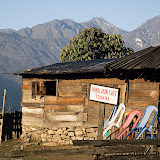
Tsokha is very picturesque in the morning. The yellow light makes the small wooden buildings glow, steam rises from the grass as frost vaporizes. The sun lights up prayer flags on the opposite side of a small pond whose perfectly flat surface reflects the sky with a blue that is deeper than the sky. The yaks are surrounded by colorful tents and trekking gear, and have an amazing backdrop of snow covered mountains. Folks, this is what I live for!!
We hike through a forest that can best be described as Tolkeinesque. The tall trees are covered in thick moss that hangs down off the limbs, deadening any sounds. The light is soft and subdued by the time it reaches the forest floor. I picture TreeBeard coming through Fanghorn Forest with a couple of hobbits on his shoulder.
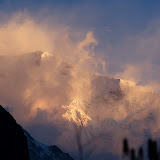
While I started the day quite weak, possibly the effect of last night's drinking binge, I end up the day feeling very strong, itching to hike some more. Bikash points me up to the Dzongri lookout and we power up the hill, me carrying all my camera gear. The sun is setting on Pandim, Jopuno, Thingchinkhang, Narsing and lights them up with a golden glow. The only thing missing is Kanchenjunga, which is obscured by the Dzongri lookout hill. I take the photos anyway, worried that by the time we get to the top of the lookout, clouds may obscure the sun.
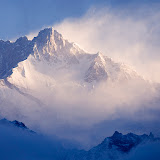
Sure enough, we arrive at the top and the clouds have rolled in. No view of Kanchenjunga. I'm getting cold and start to move down but Bikash says we should wait. He has a "feeling". His instincts are good and before the sun sets, the clouds part enough for our first view of Kanchenjunga on this trip. Cool! We finallly head down the hill and I immediately crawl into my sleeping back, down jacket on, wool hat on, pants on, socks on, gloves on - get the picture? I'm cold! I spend a miserable night, but not miserable enough to cancel plans to get up at 4:17AM so we can watch the sunrise.
----------------------------------------
Friday March 21 - Acclimatization at Dzongri
I hear the alarm in the cook tent at 4:17AM and immediately start getting up. It is several minutes of loud beeping before I hear some grunting and movement in the cook tent, where most of our crew are sleeping. I worry they will go back to sleep until I hear the 747 roar of our industrial kerosene stove. It makes the MSR Whisperlite look like a toy. Shortly thereafter I have hot milk tea delivered to my tent. It's a rough life! Now if only they would empty my pee bottle.....
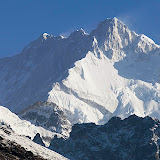
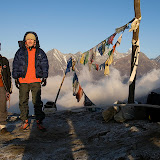
Bikash is feeling under the weather so he sends Yogish, Chodan and Passang up to the lookout with me. It is cold! At least -10C. The stream is frozen solid, there is a hard frost on the ground and the balls on the brass monkey.... well, they are still attached but they've been pulled partly inside. We climb quickly and are the first trekkers on top of the lookout. Others straggle up over the next thirty minutes, a total of ten people in all. An older couple (I have to be careful with this adjective, perhaps I should say, "Someone at least ten years older than I"), have made the trek up the hill and their guide is burning juniper branches on the small chorten at the top. The husband has brought up a bar of mint chocolate which is identical to that which Hillary took to the top of Everest in 1953. We get a picture of it with Kanchenjunga in the background. The prayer flags at the top of our lookout are stunning, as they always are in this early morning light (as are the mountains!)
Bikash and I join the Dzongri assistant caretaker, Gyahu Bhutia, for a "bamboo" before dinner. Gyahu has a small room in which he lives that is attached to the main guest structure at Dzongri. His room looks primeval, with a hearth against one wall, the smoke rising to the roof and escaping between the ceiling joists. There are bags, tools and miscellaneous belongings fastened to the wall. Everything is covered with a hairy black coating of soot. Bikash and I sit on the typical Indian stool, which supports your butt about 3" off the floor. I never did understand why they are made so low, perhaps so they don't tip over. If anyone knows, please post a comment.
Gyahu leaves Bikash and I alone for an hour and we have a very interesting and open chat. Amazing what a bit of tchang does to make one talkative.
Bikash has started his trekking company because he is not happy with the way all the other Sikkim trekking companies are run and operated. He has personal experience of other owners making decisions that are not in the best interest of clients or employees, but only to reduce work for the owner and maximize profits. (some things are constant the world over.) He notes that guides in Darjeeling make 800Rs/day while in Sikkim the going rate is about 300. Similar disparities exist for porters, yak drivers and anyone associated with trekking. He talks about how he has tried to get the trekking operators to adhere to standard rates, but invariably, when a client plays off one trekking company against another, the price per day gets dragged into the dirt, around $20/day. At this rate, everyone loses, in many cases even the client loses because the level of service or safety is compromised.
In Darjeeling, the Himilayan Mountain Institute has been able to get the different operators to adhere to minimums, thereby improving the situation for employees and guaranteeing a minimum level of support for clients.
Bikash wants to be remembered by his employees as someone who fought to improve their lot. Throughout the trek, I see this driving force within Bikash and witness the effect on his decisions. It is heartwarming to see.
From my side, I try to help Bikash analyze the situation. There are over 80 companies in Gangtok, the capital of Sikkim, which offer trekking services. In any industry, if you have that many competitors, it will only be the top one or two companies that make any money, all the rest fight for table scraps. I counsel that he needs to differentiate himself in some way, so that he no longer competes with all of them, but creates instead a unique niche which he can defend and which clients are willing to pay more for because of the differentiation. I suggest that if he could offer a wireless service to his clients while they are trekking, it will attract the affluent clients able to pay more. We kick around a few other ideas.
Bikash's sense of what is right extends beyond employees to encompass the general populace. He notes that whenever there is a dispute between Darjeeling and Sikkim, Darjeeling finds a way to block the only road into Sikkim, causing the price of rice and other staples to increase by several percent. This applies pressure on Sikkim to capitulate on whichever issue is hot at the time. He cites other examples of things he would like to see changed.
I suggest to Bikash that with his keen awareness of important social issues, he would do well to go into politics. He laughs and says he could never deal with the politics and corruption that exist in the government.
I spoke to another person who told me that to secure civil servant government jobs, like fireman, police, or administrators it is first necessary to complete a battery of tests. After the tests, applicants are expected to pay for the privelage of obtaining the job. This payment (bribe) can run into hundreds of thousands of rupees (>$10k, a LOT of money for these people).
-------------------------------------------------
Saturday March 22, Dzongri to Thangshing
Today dawns perfectly clear and I'm outside snapping photos by 6AM. My thoughts are to stay close to camp, but the mountain views keep drawing me higher, just a little further, just a little further, until I find myself thirty minutes away at the top of the Dzongri lookout. I'm the only person at the lookout, and I feel so at peace with the mountains. I'm not a religious person but the quiet grandeur and totally clear air combined with the immensity of the view strikes a chord deep inside and makes this a semi-religious experience. I linger, despite the cold, reveling in this unusual feeling.
The cook staff are programmed to provide a feast and make me feel like a king. They provide at least five different things at breakfast. Corn flakes, eggs, porridge, chapatti, pancakes, hot chocolate, milk tea, black tea, orange juice, toast with jam and peanut putter are the standard choices. They always give me a stool on which to sit, and surround me in sea of food and drink. While eating, I'm the center of attention, as the others look on, seemingly with rapt attention, lest I need anything which is not within reach. After I finish eating, the trekking staff cleans up, chucks out whatever I have not eaten, and then make rice and dahlbat for themselves.
I've talked to Bikash about this, the fact that A) I don't like being singled out as a god, I would much prefer if we all ate together rather than me sit in a throne with my subjects around me, B) I don't need more than one or two main dishes and the quantities of each prepared is waaaayyyy too much, and C) if I can't eat everything, then please don't let the extra food go to waste, have the trekking staff eat it. Bikash tries to convey my thoughts to the cook staff, but they are so used to serving clients who want the "king" treatment, that it is difficult for them to grasp that I just want to be treated as one of the guys. Bikash eventually tells them that it's really what I want, and any tips given at the end of the trip will be reflected in part, by how happy I am with my mealtime wishes. This seems to get through and both the number of dishes and quantity of food prepared start to fall in line with my desires. This morning breakfast consists of tea, corn flakes and chapatti. I consume it greedily, as I've already had a good morning workout.
At 10AM, thin patchy fog rolls in, obscuring the peaks as we trek towards Kukchurong. Bikash takes Tashi, Passang, Chodan and I on a side trip, wanting to show us Kabru Lamchu, a small sacred lake located at the foot of Black Kabru, the sacred mountain which is forbidden to be climbed. The Sikkimese believe that many of the mountains in this area are inhabited by gods, and must not be climbed for fear of offending them. Black Kabru and Pandem are two such mountains, and Bikash says it would go hard on anyone caught climbing these two mountains. Others, such as Kanchenjunga, are also sacred, but climbing permits are granted that allow the climbers to get within 10m of the summit, close enough to prove that you could do it, but far enough from the top to respect the sacred nature of the mountain.
Kanchenjunga is interesting, as it straddles the border between Sikkim and Nepal, and the Nepali have no scruples about granting permits, so most climbing expeditions will climb from the Nepal side, and thus avoid the summit limitations imposed by Sikkim. I suppose any gods associated with these mountains must be intelligent enough to distinguish between a Sikkim approach and a Nepal approach.
Kabru Lamchu Lake is frozen, the ice covered with a blanket of untrammeled snow, and surrounded by hills on all sides. In most mountain states it would be called a tarn, taking less than ten minutes to walk the circumference. We find the usual prayer flags, ceremonial silk scarves (khada), and cairns that accumulate in such sacred places. Bikash has a string of prayer flags that he ties up between two poles. Passang and Chodan tie a couple khada to one of the cairns by the side of the lake and then proceed to chip some chunks of ice from the frozen lake. We all take some of the ice and bite off a small piece to chew, taking the rest of the ice and rubbing it across our heads, but only in one direction, before letting it fall to the ground.
Some rice grains and juniper sprigs are next distributed amongst our small party. The ritual calls for each of us to make a wish (my wish is for happiness), followed by throwing a few grains of rice and juniper sprigs onto the lake's ice. This is repeated three times. The last throw includes a coin if you happen to have one (I do). If we had matches with us, we'd have burned a few juniper boughs to perfume the air for the Gods. Bikash and Tashi make prayers beside the prayer flags before we all walk around the lake in a clockwise direction. Buddhist ritual dictates that anything sacred in Buddhism be circumnavigated in a clockwise direction, an odd number of times, excepting 108, which is extra special. We walk around the lake once, and fulfill the odd number requirement.
Passang and Chodan do one last thing before we return to the main trail, they collect two bottles of ice chips and water from the lake. This sacred water will be treasured by their respective families and used for special blessings and ceremonies over the coming year.
The main trail descends steeply from the Dzongri plateau, and is covered with snow and ice in sections, making for a treacherous descent. The trail is very uneven, resulting in the odd rock or patch of dirt being exposed through the ice. I pick my way carefully down the trail, keeping rock or dirt underfoot as much as possible. Even a small tip of rock under my boot is enough to prevent me careening on the icy slope, but its slow going. The five of us who went to Kabru Lamchu are tired, hungry and thirsty after passing Kukchurong en-route to Thangshing. The sight of Bhim walking down the trail to greet us, bearing a teapot full of hot orange drink (tang), fills us with renewed energy for the remaining twenty minute walk to Thangshing.
After dinner, I join Bikash and three other guides who are crowded in the Thangshing caretaker's living quarters. Sanman, the caretaker, lives in a stone dwelling that is 6' by 8', smaller than my office cube at Xilinx. His bed, covered by an animal skin, is against one wall and three of us sit on it, huddling as close to his stove/fire as we can. Bags of God knows what are hanging above our heads, probably food stuffs of some sort. The other three are sitting on a bench against the opposite wall, also huddling close to the fire. Shelves occupy the end wall of this room, holding Sanman's spices, eating utensils, and jars containing more food. The wood stove, which provides heat and light in addition to cooking, throws off smoke that rises in the room and vents between the rafters. The uppermost shelf containing drying firewood, is festooned with hanging boogers of soot. Look at the photo, it's quite a sight.
Apparently its unusual for a trekker to join this crowd, and I entertain them by trying to pronounce Nepali words. If you ever find yourself needing to entertain some crusty men in Sikkim, trust me, just try repeating some of their words. Invariably your pronunciation will be a bit off, and it causes them to guffaw endlessly. Most of the conversation is in Nepali, but I still grasp the essence of the conversation, much of it bawdy in nature, followed by much laughing. Bikash speaks almost flawless English, and Sanman can speak pretty well. The other guides speak about as much English as I do Nepali.
Sanman sells tchang at 40Rs per fill. Pretty cheap when you consider the punch it packs. Bikash reserves a significant chunk of my trekking fee to buy tchang or rakshi for his team. It goes a long way to keeping them happy, as they have something to which they can look forward each day, like British navy sailors in years past. Having learned my lesson in Tsokha, I limit my consumption to one serving, but the others drink on and the talk becomes increasingly boisterous.
Sanman spends eight to ten months per year living in the mountains, looking after the huts in Thanshing, Samiti Lake, Kukchurong and Lam Pokhari, doing some limited trail maintenance, watching out for stranded trekkers, and generally keeping an eye on things within his territory. The remainder of his time is spent at his home in Yuksom, with his wife and six children. He seems happy here among the mountains, I've no idea if his family is happy to have him gone or if they wish he worked at home.
He started working almost forty years ago, as a shepherd for Sikkim's king, and got to know the mountains in this area better than anyone. I was hoping to get some good stories about the king from Sanman but apparently nobody paid any attention to Sanman during those days, as trekking was not popular and the king seemed not to care what the royal shepherd did with his time. When India absorbed Sikkim as its 22nd state, in April 1975, the king's position was eliminated and Sanman lost his job, doing construction work for a while, before taking his current position of caretaker.
-------------------------------------------------
Sunday March 23 - Thangshing to Lamune
I've started to lose track of time, the only way I can figure out the date is to look at my previous day's notebook entry, or, more reliably, look at my altimeter watch which indicates the day and date. This is, on the whole, a good thing. Many other things are tied to the date - my job, the hectic pace of life in Silicon Valley, all the world's troubles, George Bush,... - so losing track of the date is just a metaphor for being absorbed in the moment. Focusing all my senses on the here and now. Just what the doctor ordered.
The views of Kanchenjunga that I take for granted are unceremoniously obliterated at 10AM, as fog covers our camp within sixty seconds. It's like someone turning out the lights. The fog hugs the ground while walking up the Thangshing Valley, but occasionally a hole in the fog passes overhead and we're rewarded with views of the big mountains shrouded in mist.
It's cold and windy at Lamune and all of us are needed to help set up the tents. Tashi, the yak owner and driver, is a master of logistics, orchestrating who needs to do what to ensure the tents don't blow away as we hammer pegs into the frozen, stony ground. The latrine tent is the biggest challenge, being flimsy and having wimpy guys, but somehow it too is set up. This is a good thing, as the gusty wind is coming from all directions and it would be difficult to avoid peeing into the wind.
I've always enjoyed blustery conditions like this, it makes me feel so alive. I walk away from camp and find a sheltered spot where I can sit down out of the wind, and yet feel part of the landscape being buffeted by the weather. It feels so special, being alone and so close to so many BIG mountains. I talked yesterday of having an almost religious experience, its the same this afternoon as I get intermittent views of the peaks. I feel at peace with the world. I haven't felt this way since 1979, when I did a long solo hike through the Canadian Rockies, seeing three other people over the course of a week. There was much time on that trip to think, and to commune with nature.
I contemplate my "journey", looking for a higher sense of purpose than just logging miles, taking good photos and documenting the trip. I relate to a statement made by Elizabeth Gilbert, in her book, Eat, Pray, Love, where she says, "But my one mighty travel talent is that I can make friends with anybody." As I look back on my trip, I have the same quality. I connect with people quickly and build a sense of trust with them. They tell me things, lots of things, including their dreams, ideas about their businesses, about their countries, their people. I have another unique ability that very few of the indigenous people have. I understand some basic principles of business, I understand marketing/sales and how western people think. I can help these people accomplish their dreams, because I can look at what they are trying to do, apply a few basic principles, and make suggestions on things they should or should not do in order to achieve their goals. Many of their personal and business goals involve selling more to western tourists, whether it is service related products, like treks, or souvenir related.
I ruminate on how I can leverage these findings into something that both helps the local people, as well as making me some money along the way. It's always best to have a win-win situation. I realize that getting my photos and/or writing distributed more widely can accomplish both goals. It effectively advertises for the local people while compensating me, and it provides the overriding sense of purpose that can link together travel to many countries and locations around the world. It's an "aha" moment for me and one that I continue to ponder for the remainder of my travels before returning to the US.
It also has the potential to provide more stability to my personal life. I say this while realizing it might not look this way to the casual observer. How much stability would there be if I'm globetrotting to exotic locations? At the same time, knowing that's what excites me and what I'll be doing in one year or three years from now does provide some continuity. To be sure, it's different from being the chief strategist at a fortune 500 company, but if it floats my boat, isn't that what we're all trying to do? Float our own boats as high as we can?
---------------------------------------------------------------------------------
Monday March 24 - Lamune to Kanchenjunga Lookout to Thangshing
Today is all about viewing Kanchenjunga, up close and personal. My ten day trek is called, "The Goecha La Trek". Goecha is a mountain located very close to Kanchenjunga, "La" is Tibean for pass. Hence, "Goecha La", is a high mountain pass next to Goecha mountain. It's the lowest pass connecting the Okhlathang Valley (the one I'm in) to the equivalent valley to the north, and the trail from Lamune to Goecha La affords the closest views of the great mountain. Any closer and you'd be climbing. This is why people do the Goecha La Trek, to get outstanding views of Kanchenjunga.
I push the team for an early departure, hoping to catch the sunrise. Bikash is feeling under the weather, sending Bhim and Tashi to guide me on the trail. Chodan and Passang also come, as this will provide them good practical experience for their tourism classes. They are both wearing running shoes with thin socks and when I see three inches of fresh snow on the ground, I insist they each wear a pair of my heavy socks. It's common for guides, porters and other locals trekking to make do with very limited gear. For example, its 4AM and I'm the only person to have a headlamp. I'm not sure how Bhim and Tashi are able to follow the trail without one. In spite of not having the proper clothing and equipment, they all remain cheerful and I never hear any complaining.
Viewing conditions are less than ideal as clouds shroud the mountains preventing the early morning sun from lighting up the peaks. However, the glacial valley with high mountains on both sides is impressive, it feels like we are in a giant cathedral. It is bloody cold at the lookout, with the water in my bottle freezing. I can only imagine how the girls would fare had I not given them heavy socks. My hands are freezing as I futz with my camera, taking panoramic pictures using my tripod.
Tashi and the girls brought a set of prayer flags and a khada to leave behind at the lookout. As they busy themselves setting up flags and khada, Bhim pulls out the traditional Sikkim treat for high altitude, popcorn. I have a hard time believing this, since popcorn has little calorific content, but they swear by it.
Energy seems to seep from the mountains, be radiated by the prayer flags and even feels like it flows from the numerous glaciers. Perhaps part of this is due to standing on the base of Mt. Pandim. Bikash has told me several times that anyone who gets close to Pandim feels the sacred power emanating from the mountain, as though there is a secret energy source inside. Bikash, like many Buddhists in Sikkim, believe strongly that the mountains harbor enormous power and some form of sentience. These widespread beliefs are what caused the government to forbid climbing some of the mountains and others, like Kanchenjunga, are to be climbed to within 10m of the summit only. While I remain skeptical of such supernatural explanations, I can say that I feel like a million bucks, stoked, pumped, strong and invigorated by the energy of this place.
Despite feeling strong, we all feel cold, really cold, and I make the decision to head back to camp before reaching Goecha La. I believe the views from this location at 4,600m are better than we'll get if we continue, even though the pass is at 4,900m. Another consideration is that the trail deteriorates beyond our current location. No big deal under good conditions, but with snow and ice on the trail, making it both hard to follow and very slippery, it does not look safe. The team is very happy with this decision. The fresh snow and the rising sun combine to provide outstanding photo ops on our way back to camp and my little diversions add at least an hour to the return journey.
After lunch, I take pictures of Chodan and Passang as we walk back down to Thangshing. Every time I set up to shoot, they stop walking, put on serious faces and it all looks very contrived. Try as I might, they don't understand that I want them to continue walking and look natural as possible as I take photos. I finally resort to pantomime, imitating their stoic faces and forced poses and then contrasting that to me cavorting down the trail. The exaggeration works, they howl with laughter but get the message and act much more naturally next time I shoot. This behavior of static stoic poses for the camera is common throughout my travels. Come to think of it, western children often do this, perhaps it is a natural human reaction when putting the spotlight on someone.
I read more of "Eat, Pray, Love", and see more parallels to my personal situation, getting divorced and moving quickly into another relationship. It's a delightful book, well written and I strongly recommend it, regardless of whether you have relationship challenges or not. I spend more time thinking of my situation and come back again to the idea of writing for outdoor magazines, it holds great appeal.
The girls have been teaching me words in Nepali, but they've been rather haphazard about the choice of words we learn, a few numbers, a few colors, a few phrases. I take a few minutes and jot down lists of English words for which I would like to have the Nepali equivalents. I realize that the biggest thing I need are common phrases, interrogative words and some conjunctions to stick phrases together. It would be nice to have a few phrases like, "the food is good", "I'm coming for breakfast", that would be useful around the camp. Then I have a wicked idea and go straight to see Chodan and Passang.
They fill in my lists and then we get to my special project. How to say, "Bikash is farting today". They have never heard the word fart. I try explaining using other common words, and then try pantomiming gas escaping my ass but its not till I make some fart sounds that they finally get it. Their faces show in rapid succession, disbelief, shock, mirth, and when they put the pieces together and imagine me saying this to Bikash, they laugh uncontrollably. "Aza Bikash padnu cha", is the magic incantation. They have me repeat it over and over, laughing each time, and then send me in to Sanman's small den of iniquity, where the tchang is flowing freely, and the boys are in good form.
Bikash, Sanman, and the other guides laugh at my newfound fluency in Nepali, but the reaction is less than I expected. They have more fun saying other Nepali words and listening to my butchered attempts to repeat the words. In truth, after having some tchang, we all laugh at just about anything. There is one particularly good story teller in the group. He is so expressive, pausing in the right places, raising his voice when needed, and using hand gestures, that despite my lack of Nepali language skills, I can follow the gist of his stories. Later, over dinner, Bikash playfully chastises the girls for teaching me bad words and we all have a good laugh.
------------------------------------------------------
Tuesday, March 25 - Thangshing to Lam Pokhari
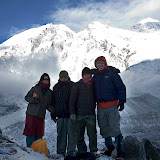
Our little trekking band has become quite close over the past week. Bikash tells me that I'm unusual and he and his team have never had a client who interacts as much as I do, getting close to the team in the process. It reminds me of the Fellowship of the Ring, from The Lord of the Rings, and I'm sad that Chodan, Passang, Tashi and one of porters must head down the hill today. That leaves Bikash, Bhim, Jiwan and Gyalpo to accompany me to Lam Pokhari.
We are the only occupants of a wooden hut at Lam Pokhari. It is small, about twenty feet on a side, with a small cooking area appended to the side. This appendage has a hearth lined with stone for building a fire and we make good use of this in the evening to keep warm.
A yak managed to get its head through some of the cross bracing underneath a porch railing. Unable to get its head back out, it starved to death. Based on the smell and level of decay, we estimate its been dead about a week. The yak provides at least an hour of entertainment, as the boys hold up its head for pictures, then ram a 2x4 up its ass to act as a lever for moving it away from the cabin. We drag, roll, push and otherwise get it far enough away that the smell does not permeate our sleeping quarters. Bikash tells me the yak's tail is worth 12,000Rs ($300) at the market. It's certainly tempting to cut it off but Bikash says that stealing something like this would likely be found out and would land you in big hot water.
Bikash and I spend most of the afternoon together discussing a variety of topics, starting with his trekking business which he started several months ago. I enquire how he finds clients. He tries to make friends with hotel owners and have them direct clients to his business, but he says this is difficult, there are many hotels in Gangtok. I point out that he probably only needs to worry about 5-10 hotels. The most affluent clients will stay in one of about three hotels so he needs to focus there. The less affluent folks will stay in the hotels recommended by Lonely Planet, which is only a handful. Then I suggest that he look for other places where most customers will go. The obvious one to me is internet cafe. Most travelers these days want frequent internet access. The number of internet cafes in Gangtok is quite small, about five, so this is a natural place from which to steer people toward Bikash's business.
Bikash tells me how he is enticing some of his employees to work harder, smarter and clean up their personal lives, by offering them junior partnerships in his company. One thing he is particularly firm about is he doesn't want any of his guides using drugs. As a result of Bikash's efforts, one of his guides has gone from being a frequent marijuana user, to no usage whatsoever. I inquire as to what prompted his strong feelings about marijuana usage and he shares a funny story. Many years ago he and a friend got some marijuana, took it to a forest and smoked quite a bit. Bikash felt nothing, until he stood up to move, at which point he felt that he was flying through the sky and promptly sat down. He spent the next several hours sitting in front of a tree, mouth hanging open, hands scrabbling in the dirt, looking for a specific root that had water in it.
This reminds me of my experience smoking cigarets. When I was seven years old a group of my friends got together and smoked for the first time. I have vivid memories of smoking only a single cigaret, and then feeling so sick for the next several hours that I've not touched them since. In looking at all the drug and tobacco usage, it would seem that Bikash and I are oddities in this world today.
I share with Bikash that Chodan had the hots for me and he said he was not aware. He relates a story that when he was in his early 20's, a 13 year old girl pursued him vigorously to the point where Bikash went to her parents to ask for help and eventually even the police got involved in keeping her away from Bikash. The more I learn about Bikash, the more impressed I am with his sense of ethics, his ability to discern right from wrong, his knowledge of what the average man on the street needs, and his aversion to corruption, especially in the government. I hope that Bikash's business can be wildly successful as he would then have increased ability to make positive changes in people's lives and also force positive change in government.
It's dinner time before we know it and everyone huddles around a small fire in the cook area. The guys sing a few songs and try to get me to sing some. I refuse to sing any western songs (I can never remember the words) but I sing along with some of their Nepali songs. This leads to more word repetition. It amazes me how entertaining I can be just repeating words they say. Then one of them says, "laro", and when I repeat, it brings the house down. Tears are streaming, a couple of the guys almost burn their boots in the fire when they prostrate themselves laughing. I repeat it a few times and get the same response each time. One of them finally tells me it means penis. Bikash is laughing as hard as the rest but does tell me, NEVER say this word in public. Another whole round of this erupts when they modify my word to, "laro ka", suck my dick. Boys will be boys, the world over.
-----------------------------------------------------------
Wednesday, March 26 - Lam Pokhari to Kukchurong
I've developed quite a reputation amongst the team for getting up insanely early, sprinting to a lookout and snapping photos of the mountains while the sun rises. Bikash is getting quite a reputation of delegating guiding duties during these early times to Bhim, a porter and cook's helper. I've found Bhim to be an able guide, a good sport, and developed a great relationship with him. Next to Bikash, Bhim has the best English of any of the trekking crew. This is a huge advantage for me, as I can explain exactly what I want to do, and we can have interactive discussions about best routes up the mountains. We've developed a routine whereby I carry my camera only, and Bhim carries my pack containing tripod, lens, flash, food, water, extra clothing and anything else I decide to put in. When Bhim is loaded with twenty-five pounds, and I am unloaded, the 49 year old man is able to just able to keep up with the 18 year old, that is to say, we move fast as a team.
The area around Lam Pokhari is very rocky, with juniper and a low gorse-type ground cover that is difficult to walk through when thick. The trick is to find loosely packed gorse areas where you can wend your way between individual bushes without getting too badly scratched. The hut is on a flat bench, below which the mountain drops steeply. Above this bench to the north is a wide bowl whose sides steepen as you gain elevation. The sides are covered with gorse and other vegetation having rich beautiful browns, golds and greens when lit up by the sun. The top rim of the bowl is crenelated, with almost vertical towers. Between these towers are chutes that narrow to twenty feet before opening out to broad rolling hills above. Bhim and I climb up one of these chutes, gaining about 1000 feet, and then run like hell to the west in order to get a catch a view of the sun coming up on the big mountains. We do catch alpenglow on Kabru North, but Kanchenjunga is obscured by taller peaks in front of us.
Bhim thinks he sees a place higher up where we'll be able to get a view of Kanchenjunga and we sprint off. The higher elevation and previous exertion start to tell on the old man and Bhim leaves me in the dust. We get some fine views before heading back down, toward the cabin. Down climbing is always more difficult than going up, and it takes us longer to pick our way through rocks, towers and gorse. At one point we end up on a promontory from which there is no way forward, but Wow, what a view of the cabin and the valley below. We see Bikash, Gyalpo and Jiwan watching us so Bhim and I synchronize a loud yell of, "Laro Ka". We hear their faint return call and know instantly that a new secret greeting has been established, just for our team, and make a few more calls. In fact, I should point out that it's much more versatile than it first appears. For example, the previous exchange really transmitted the following information.
Bhim and I, "Laro Ka!" (Greetings smelly underlings)
Bikash, "Laro Ka?" (You guys OK?)
Bhim and I, "Laro Ka!!" (Hell, yah!)
Bikash, "Laro Ka!!" (Go fuck yourselves!)
Bhim and I, "Laro Ka!" (Suck my dick!)
We scramble over rocks, heading east, to Lam Pokhari Lake. We're on a steep ridge, 700' above the lake, and the fog starts playing games with us, completely obscuring the lake, then blowing away, then surrounding us. It's magical how the views and the ambiance change so rapidly. One minute things are hushed, quiet with dull muted colors like a somber cathedral. The next minute the fog lifts, we hear the wind, birds and see the lake and surrounding mountainsides as though they were, well..., a beautiful lake surrounded by mountains.
The trail back to Thangshing has long sections covered with snow. One section is both icy and steep, making a real challenge to get the yaks across. The yaks attempt crossing a couple times, slipping, and they become gunshy. Bikash takes the ice axe and chops steps up the ice. I'm amazed the yaks are able to find the steps with their feet, but they get enough purchase to make it across the scary section. We pass through Thangshing on our way to Kukchurong.
The hut at Kukchurong is packed, trekking season must be starting in earnest. I meet two German couples that I met briefly on the trail. We have a delightful animated conversation for a couple hours. In fact, I'm conscious of the fact that I have not said boo to my trekking team during this time. I've been with Bikash or someone from my trekking crew virtually all the time for the past week. Spending time talking to Norbet, Walter and their wives makes me realize how much I value interacting with other western people. There is a increased level of brainpower required to interact with my trekking crew. Part of this brainpower is required to compensate for language. It takes effort on my part to continually stay tuned in to them. Even with Bikash, whose English is very good, word order is sometimes different, there is some accent and it takes some work on my part to understand. It's much more work to follow the others. I also compensate when I speak, using simpler words than I might otherwise use. Then there is energy expended in constantly filtering what I say, asking questions like, "Will they be offended if I talk about this?", "Are there cultural considerations I need to be aware of?"
The bottom line is that I find it refreshing to spend a couple hours chatting with Norbet, Walter and their wives. Even more interesting when I learn the Moellers would like to visit California in the next couple years. I tell them to look me up. And I learn that Walter and his wife have climbed all over the world. He tells me about climbing Island Peak in Nepal and this sets off a chain reaction in my brain, thinking, "Well, why not climb a peak in Nepal?" My previous thought had been just to do a trek, but Walter's description made it sound feasible. I will at least check into it.
---------------------------------------------------
Thursday, March 27 - Kukchurong to Doring
I have many good shots of the mountain by this time but I don't have one showing alpenglow, the intense orange color that highlights the mountain for the first 10-15 minutes after the sun's first rays shine on the mountain. Every time previously that I've tried, there have either been clouds in the way or I haven't had quite the right angle.
It's increasingly clear that I'm very very driven to get the best photos I can. Some might call it an obsession? Thangshing is two miles back up the trail toward Kanchenjunga and I've arranged to have Bhim accompany me to the Thangshing lookout, eight hundred feet above Thangshing. We get up at 2:45AM and are on the trail by 3:20AM, absolutely smoking. It takes us only 35 minutes to Thangshing. The steep climb to the lookout slows us a bit but I'm in position with camera mounted on tripod by 4:30AM.
We have to wait almost an hour for the sun to poke its head up and its bloody cold up here. I've got my down jacket and other warm clothes while Bhim has his relatively thin jacket and a towel. He refuses my offer of extra clothing and putting the towel over his head, finds a spot out of the breeze, lies down and goes to sleep! I pace up and down trying to stay warm. The sun finally shows but the clouds are not being cooperative, I don't get my killer shot and by 6AM we're back on the trail, booking back to Kukchurong.
The light along the trail is superb, lighting up rocks in the river, highlighting frost, backlighting mossy trees, illuminating multiple ridge lines, and making everything look its absolute best. If I'm ever close to this region again, I will make a point to come back to this area for another early morning of shooting.
After a quick breakfast, we climb the icy trail up the escarpment. Starting from Kukchurong, the forest gradually gives way to grassland, scrub and low trees as we gain 1500 feet and lose the lea side of the escarpment. I periodically get ahead of our team (limited in speed by the yaks) and use our special greeting whenever I see them coming. They love it. Bikash and I break off from the main trail, heading a bit west to the four chortens. These commemorate the meeting in 1642 of three regional chogyals (kings) who agreed to merge their kingdoms and form the country of Sikkim. Three of the chortens represent these three individuals, while the fourth, which is larger than the others, represents God. A thin layer of cloud alternately shrouds the chortens, then leaves them in sun, lending a mysterious air to the place.
It takes thirty minutes to walk across the open hills to our camp in Doring. The team have already set up tents and are making me tomato and garlic soup, one of my favorites on this trip. It packs quite a bite (both directions) but is really tasty. After lunch, Bhim tells me he has a surprise for me, and proceeds to pour a clear yellowish liquid from a bottle into my cup. Earlier I explained to them the standard mountaineering practice of peeing in a bottle at night so that you don't have to leave your tent during the night. I look at the yellow liquid in my cup, look at Bhim, look at my cup and then ask Bhim to drink some first. I can't believe he would be so cruel, but I don't want to take any chances either. After he drinks some, I enjoy a most delicious lemon drink.
Bikash takes a fifteen minute walk over the hills to the Dzongri hut to see friends, and perhaps more importantly, have some tchang. Returning at 5PM, he invites me over to Dzongri, saying that a friend of his is guiding two single women and I should come and meet them. I mentioned earlier that it was refreshing to chat with the German folks this morning, so I head on over with Bikash, sharing a tchang with him until his guide friend has organized a dinner between myself and his two clients.
Amanda is originally from the US, but has lived for 18 years in Australia, while Lisbeth is from Denmark. We have an enjoyable evening chatting, in spite of frequent interruptions from either Ong (Bikash's guide friend) or Bikash. It feels as though Ong and Bikash are parents, checking up on their children. Ong is getting a bit drunk and makes some rambling discourses when he pokes his head in the room where we're eating. Amanda, Lisbeth and I agree to meet up on the Dzongri lookout tomorrow morning at sunrise.
Our cook back in camp has prepared yak meat for dinner, and even though I'm pretty full, I'm curious to try it. It tastes like tough stringy strong-flavored beef.
--------------------------------------------
Friday, March 28 - Doring to Bachim
Bhim is becoming a fixture on my early morning climbs, preparing something hot before we set off, carrying my pack, guiding me, and pushing me in pace. It's great, he's such a positive person. We beat the sunrise again, meeting Amanda and Lisbeth at the Dzongri lookout. Amanda brings tea, which is very welcome as it is again very cold up here.
The clouds streaming from the top of Kanchenjunga interfere with my alpenglow shot, although North Kabru is very cooperative and provides the deep orange color. I find the experience to be less moving than my previous times viewing the mountains. Either I'm becoming jaded by so many opportunities of viewing these monsters, or, more likely, with a dozen people at the lookout point, the atmosphere is less intimate. It's harder to form the direct connection with the mountains when eleven other are people are competing for my attention. It begs the question if one was to climb Everest these days, and find ten or twelve people at the top, if the experience would be the same as it would with just you and your climbing partner. I expect for me, the experiences would be quite different.
Bhim and I amble down to camp. The light is so good, I can't resist multiple photo ops on the way down. We're near the end of our trek, and it's a slow day. Bhim loves cricket and spends time practicing his bowling skills, while Bikash and Tashi are in deep discussions working out plans to create the largest trekking company in Sikkim. The others lounge around, and slowly the tents and other gear are packed and loaded onto our yaks for the journey down the hill.
Bikash and I discuss more aspects of his business as we make our way over the open hills to Phedang, the start of the steep downhill through pine forest to Tsokha. He tells me that Bhim is his most promising employee, who has the potential to run this whole operation in five years time. Bikash contemplates Bhim staying with Bikash's family during the slow monsoon season, in order to improve his English skills. I see this as another example of Bikash wearing his "big picture" hat, and not getting caught up in what's best for Bikash in the next thirty days, like most people.
We take a short rest at Phedang (3760m) and then start descending. As we get lower, the pine forest becomes more verdant, and we start seeing rhododendron periodically. In particularly wet sections, the trail has been augmented by what I would call, "corduroy", where logs are placed crosswise on the trail, providing solid footing through what otherwise would be deep mud or bog.
I'm starving by the time I get to Tsokha (3050m), and head straight for the Himalaya Cafe. A short burley Kiwi, Simon, has arrived just before and is tucking into a chocolate bar. I do the same for some quick relief, but get a heaping plate of chicken vegetable noodles to do the real job of plugging the hole in my gut. A serving of tchang rounds out the meal.
The cafe has dirt floors and the walls are built from rough, hand-sawn boards. It could not be more rustic. It's about eight feet by sixteen feet, roughly divided in half. One half has the fire/stove with benches around the perimeter, and is used for kitchen, warming area (it gets cold at night) and tchang drinking. The other half is further from the fire, closer to the door, and has a rustic wooden table for eating. I start at the table and migrate to the kitchen after satiating myself. When I arrive, around 1PM, there are just a few folks, but it gradually fills over the next few hours. The place gets packed in the evening, when all the trekkers have camped here for the night and are looking for food, grog or just entertainment.
I meet a couple climbers, Jason and Josh, from an American expedition that spent a month climbing on Jopuno and Thingchinkhan. They have some good pics which are annotated so you can follow their adventure at:
http://www.vla.com/josh/India08/CH2_climbing/index.htm
They had very bad luck with the weather, it snowed almost every day which is unusual for this time of year. They did summit Jopuno, and had some exciting stories of climbing over snowy rock with more snow dumping down. Kinda scary.
I also met their liaison officer, Suraj, who is a cousin of Bikash. The liaison officer accompanies the expedition to base camp, ensures that they don't disturb the flora and fauna, verifies they pack out all of their garbage, and keeps notes on the expedition. They don't actually participate in climbing. The concept of a liaison officer is common in developing countries like Sikkim and Nepal. I think it is a good thing, providing employment, keeping the expedition honest and giving some mountaineering experience for the local people.
Bikash and I leave Tsokha at 6PM and meet the rest of our crew at Bachim, an hour down the trail. We stay in an old house that is being rented as a lodge. The ground floor consists of a large open room, where all the trekking staff sleep, prepare meals and generally hang out. It is pretty scary when its dark and there are four or five large kerosene burners all blaring away. The only light is that given off by the stoves, making for some eerie shadows, the burners are incredibly noisy and the burned kerosene smell in that confined space is not pleasant. There are rooms upstairs which are occupied by trekkers, like me, although it's full when we arrive and I sleep outside in my tent (I'm happy to have my own space).
------------------------------------------------
Saturday, March 29 - Bachim to Yuksom
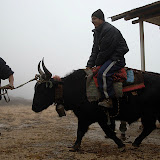
Morning finds me shooting a few photos when a baby dzo comes and starts pushing me around with its horns. I've been liberal in my usage of the word yak. Almost all the animals used as beasts of burden are more accurately called dzos, a cross between a yak (long hair) and a cow. Dzos are hardier and more vigorous than either pure breed, similar to mules. This small one is forcing me against a fence and I grab the dzo by the horns and push him away. I discover that you can push him relatively easily but pulling the small dzo is almost impossible, he's able to dig in his heels and stand firm.
The scenery on the way down is dominated by white rhododendrons, even though they represent only 1 in a 1000 of the trees. They stand out from the crowd, so to speak. Bikash and I hike down together and the vegetation changes as we descend, becoming less forest and more jungle, with bamboo, vines and broadleaf plants starting to dominate the scene.
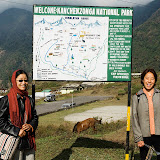
There is a park ranger office as you exit the Kanchenjunga Park and enter the town of Yuksom, and everyone is supposed to check in with the ranger as you both enter and exit the park. The ranger says that someone reported that Bikash has guided two clients on a permit showing only a single client. It takes thirty minutes for us to convince her that this is not the case, that I'm the sole person Bikash has been guiding. The next thirty minutes is spent explaining why Bikash is two days longer than his permit allowed. On the way out, the ranger tells Bikash that they want to see him at the police station.
As we pass the police station, Bikash says the police will find him quickly if they want him. We stop at a small restaurant and I get a couple bananas (fresh fruit!!) and a one liter bottle of lychee juice. I'm in heaven. About the time I'm finishing, an officer pokes his head into the restaurant and pulls Bikash aside. As I leave, Bikash directs me back to the Dragon hotel while he accompanies the officer back to the station.
I learn later that Bikash was arrested for staying in the park two days beyond his permit. I can't believe it. Arrested! Not only that, but they send six officers to make the arrest. Someone is definitely trying to damage Bikash's reputation and prevent his business from being successful. We learn later that a previous boss of Bikash, whom I'll dub, "Asshole", is behind all this. Asshole is worried that Bikash's new trekking company will be successful so he is trying to cut him off at the knees, using the police and other government officials as pawns.
Bikash's uncle posts bail and Bikash is able to move around town on his own, however, he cannot leave Yuksom until this business is cleared up. This means I will trek to Khechuperi tomorrow with Jiwan, Bhim and Gyalpo while Bikash and Tashi try to sort out his situation. I do what I can to help, which consists of calling Tashi Gilli, the government official in charge of all permits. It's clear from my discussion with him that Mr. Gilli does not want to get involved.
It's with a sad and agitated heart that I make my own way to the Dragon Hotel, where I'm to spend the night. This feeling is quickly dispelled by the first real shower in over a week. No matter that the water is cold, it feels great and refreshing. I spend the remainder of the afternoon sitting on the hotel's sundeck, drinking beer, catching up my journal and sorting pictures on my laptop. I'm excited because I've got some great pics.
The American climbing expedition have arrived in Yuksom the same day and the government, in its desire to promote tourism are hosting a party at the biggest hotel in town. I head over at 9PM and spend an hour with Sam, Jason, and Sarah, three of the four climbers from New Mexico. I learn that Sarah is a fire fighter, Sam is construction contractor, while Jason and Josh (not here at moment) work at Los Alamos Labs. They look at my Sportiva boots and say that if they were to repeat, they would use something like mine. Plastics are too difficult on technical rock.
While enjoying the beer, Bikash and Jiwan poke their heads in and one of the "officials" goes outside to meet with Bikash. This official is Asshole, the ex-boss of Bikash who has it in for him. I go out to see what's going on and Asshole pulls me over, putting an arm around Bikash and telling me that Bikash is his "brother". He reminds me of "Worm-tongue", in Lord of the Rings, the character that distorts the truth to Lord Denethor. I manage to escape back inside before the vile creature can contaminate me.
Bikash stops by to see me at midnight, not sure what to do with respect to his predicament. I ask how I can help but Bikash says he will make some calls tomorrow and get it sorted out. He hopes to be clear by tomorrow evening and come and join us in Khechuperi.
Months later, Bikash learns the facts behind the bizarre incident with the police arresting him. It was indeed his previous boss, Barap Namgyal from Sikkim Holidays, who instigated things (and whom I've referred to as, "Asshole", in my narrative above). For reasons that are still unclear, Barap fabricated a story about Bikash, went to the Yuksom police and convinced them to arrest Bikash, telling them that Bikash was rich and would be able to pay a large bribe to be released from jail. Barap also told the police that Bikash had previously been arrested for injuring a policeman, another fabrication. This was why the police sent six officers to arrest Bikash. Barap Namgyal is certainly a paranoid individual, and based on events and what Bikash has shared with me, he is possibly schizophrenic and needs medical attention. Why Sikkim Holidays, one of the largest and most reputable trekking outfits in Gangtok, would continue to employ someone like Barap Namgyal is beyond me.